
Table of Contents
- ⚠️ One Wrong Step Can Freeze Your Shares for Weeks
- What is Rematerialization of Shares? (Simple Explanation)
- Why Would Anyone Convert Demat Shares to Physical?
- Demat vs Physical Shares (Clear Comparison That Changes Your Decision)
- What Most Beginners Get Wrong at This Stage
- Step-by-Step Process: How to Convert Demat Shares to Physical (Rematerialization)
- Step 2: Fill the Rematerialization Request Form (RRF)
- Step 3: Submit the RRF to Your Broker
- Step 4: Broker (DP) Verification
- Step 5: Depository Processing
- Step 6: Physical Share Certificates Issued
- Documents Required for Rematerialization
- Charges for Rematerialization in India (2026)
- How Long Does Rematerialization Take?
- Risks & Disadvantages of Physical Shares (Don’t Ignore This)
- 🚨 Reality Check (Very Important)
- Common Mistakes That Get Your Rematerialization Request Rejected
- Who Should Convert Demat Shares to Physical?
- Rematerialization vs Dematerialization (Quick Comparison)
- Final Verdict: Should You Convert Demat Shares to Physical?
- FAQs

⚠️ One Wrong Step Can Freeze Your Shares for Weeks
Most investors never think about converting their demat shares back into physical certificates.
And honestly—you shouldn’t need to.
But the moment you do need it (legal issue, inheritance, or transfer case), things get messy fast.
Here’s what usually happens:
- You download the wrong form
- Signature doesn’t match DP records
- Request gets rejected
- Shares get stuck for weeks
And suddenly, something that should take 15–20 days stretches into a month-long headache.
The worst part?
Most guides online are either:
- Outdated
- Too technical
- Or completely ignore real-world mistakes
So if you’re here, you probably want one thing:
👉 A clear, practical way to convert demat shares to physical—without messing it up
That’s exactly what this guide will help you do.
What is Rematerialization of Shares? (Simple Explanation)
Let’s keep it very simple.
👉 Rematerialization = converting electronic shares into physical share certificates
That means:
- Your shares are currently in digital form (Demat account)
- You request to convert them into paper certificates
Think of it like this:
- Demat = Google Drive
- Physical shares = printed documents
You’re basically saying:
“Give me the printed version of my shares.”
Where are your demat shares stored?
In India, shares are held through depositories:
- NSDL
- CDSL
Your broker (like Zerodha or Angel One) acts as a Depository Participant (DP).
Important Reality (2026)
According to current market practices in India:
👉 99% of investors do NOT need rematerialization
Because:
- Demat is safer
- Faster
- Easier to manage
Still, there are some situations where remat becomes necessary—which we’ll cover next.
Why Would Anyone Convert Demat Shares to Physical?
This is where most beginners get confused.
“Why would anyone go backward—from digital to paper?”
Good question.
Let’s look at real scenarios.
1. Legal or Dispute Cases
If shares are involved in:
- Family disputes
- Court cases
- Ownership verification
Sometimes physical certificates are required for documentation.
2. Inheritance / Succession Issues
When:
- Original holder has passed away
- Nominee/legal heir needs proof
Physical shares may be required in certain processes.
👉 You should also understand:
3. Offline Share Transfer
In rare cases:
- Some transfers still require physical documentation
4. Personal Preference (Very Rare)
Some old-school investors prefer:
- Physical holding
- Tangible proof
But this is declining fast.
🚨 Important Insight
If you’re a normal investor:
- Investing through apps
- Doing SIP or long-term investing
👉 You likely do NOT need rematerialization
Instead, you should focus on:
Demat vs Physical Shares (Clear Comparison That Changes Your Decision)
Before you even think about converting, you need to understand what you’re giving up.
Comparison Table:
| Feature | Demat Shares | Physical Shares |
|---|---|---|
| Storage | Digital | Paper certificate |
| Safety | Very high | Risk of loss/theft |
| Transfer Speed | Instant | Slow (weeks) |
| Selling | Easy (online) | Complicated |
| Risk | Low | High |
| Maintenance | Minimal | High effort |
Let’s break this down in real life
🔹 Scenario 1: You want to sell shares
- Demat: Sell in 10 seconds
- Physical: Paperwork, verification, delay
🔹 Scenario 2: You lose documents
- Demat: Recover easily
- Physical: Nightmare process
🔹 Scenario 3: You forget about shares
- Demat: Still safe in system
- Physical: Risk of damage or loss
👉 That’s why modern investing is built around demat.
If you’re still unclear, read:
- Demat vs Physical Shares – Complete Comparison
🚨 Strong Reality Check
Moving from demat → physical is NOT an upgrade
It’s usually a compromise for a specific need
What Most Beginners Get Wrong at This Stage
Before we move to the actual process, let’s clear confusion.
❌ Myth 1: Physical shares are safer
👉 Reality: Demat is far safer
❌ Myth 2: You’ll have more control
👉 Reality: You’ll have more headaches
❌ Myth 3: It’s easy to reverse later
👉 Reality: Re-dematerialization is another process
Step-by-Step Process: How to Convert Demat Shares to Physical (Rematerialization)
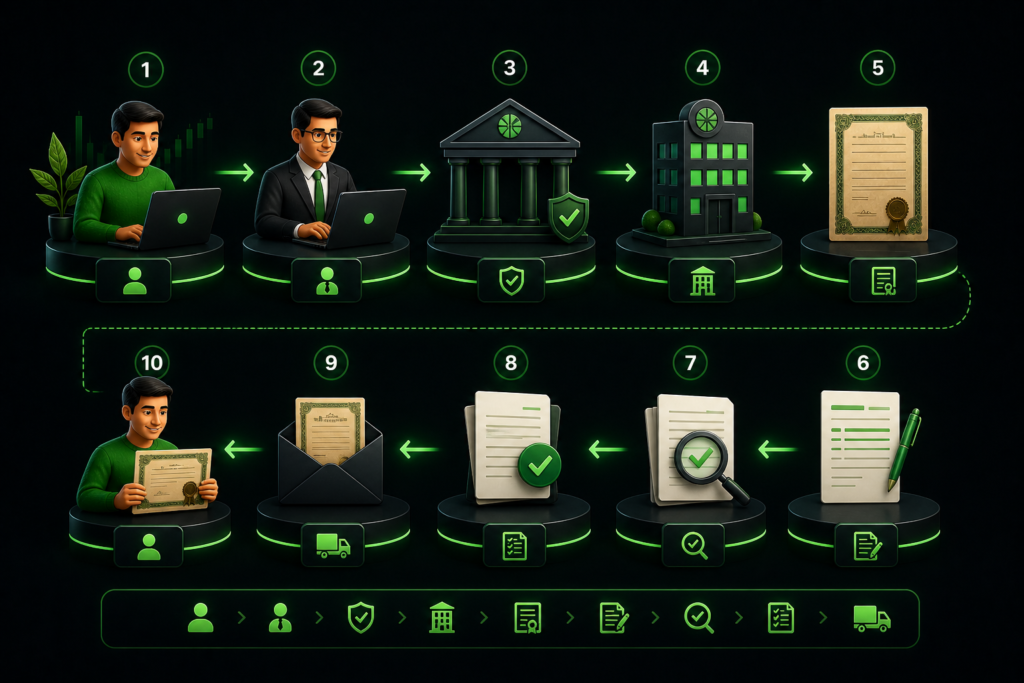
This is the part you actually came for.
And here’s the truth:
Rematerialization is not complicated—but it is very easy to mess up if you miss small details.
Let’s go step-by-step like you’re actually doing it.
Step 1: Contact Your Depository Participant (DP)
Your DP = your broker.
Examples:
- Zerodha
- Angel One
You cannot directly go to NSDL/CDSL.
👉 You must go through your broker.
What you need to do:
- Log in to your broker OR contact support
- Request Rematerialization Request Form (RRF)
Some brokers:
- Provide downloadable forms
- Others require email request
Beginner Confusion:
👉 “Can I do this online?”
❌ No (in most cases)
Rematerialization is still largely:
👉 Offline + physical form process
Step 2: Fill the Rematerialization Request Form (RRF)
This is the most critical step.
One mistake = rejection.
What is RRF?
RRF = Rematerialization Request Form
It includes:
- Your demat account details
- ISIN of shares
- Number of shares
- Signature
Key Things to Fill Carefully:
1. ISIN (Very Important)
- Unique ID of each stock
- Must be 100% correct
2. Quantity of Shares
- Cannot exceed your holdings
3. Client ID / DP ID
- Must match your demat account
4. Signature
- Must match your broker records EXACTLY
🚨 Biggest Reason for Rejection
👉 Signature mismatch
Even slight difference = rejection
Step 3: Submit the RRF to Your Broker
Once filled:
- Submit to broker office OR courier
- Some brokers accept scanned + physical follow-up
Pro Tip (Very Important)
Before submitting:
✔ Double-check all details
✔ Take a photocopy
✔ Keep acknowledgment
Step 4: Broker (DP) Verification
Your broker will:
- Verify your details
- Check signature
- Validate holdings
If everything is correct:
👉 They forward request to depository
Step 5: Depository Processing
Handled by:
- NSDL
- CDSL
They:
- Block your shares
- Initiate rematerialization
Step 6: Physical Share Certificates Issued
Finally:
- Company/registrar prints certificates
- Sent to your registered address
Timeline Summary
| Step | Time |
|---|---|
| Form submission | 1–2 days |
| DP verification | 3–5 days |
| Depository processing | 7–15 days |
| Certificate delivery | 5–10 days |
👉 Total: 15–30 days
Documents Required for Rematerialization
Let’s keep this practical.
You typically need:
- Filled RRF form
- PAN copy
- Demat account details
- Signature verification
Important:
Details must match your demat account.
If not, update first:
Charges for Rematerialization in India (2026)
Here’s the real cost breakdown.
Charges Table:
| Component | Charges |
|---|---|
| DP Charges | ₹10–₹50 per certificate |
| Courier Charges | ₹50–₹200 |
| GST | Applicable |
👉 Based on latest 2026 charges across brokers
Important Insight
- Not very expensive
- But effort > cost
How Long Does Rematerialization Take?
Let’s set realistic expectations.
Typical Timeline:
👉 15 to 30 days
But delays happen if:
- Signature mismatch
- Incorrect form
- Company delay
- Address mismatch
Real-Life Scenario
Many users face:
- 30–45 day delays
- Re-submission of forms
👉 That’s why accuracy matters more than speed
Risks & Disadvantages of Physical Shares (Don’t Ignore This)

Now comes the most important decision section.
1. Risk of Loss or Theft
Physical certificates can be:
- Lost
- Stolen
- Damaged
2. Selling Becomes Difficult
You cannot:
- Sell instantly
- Use trading apps
You’ll need:
- Re-dematerialization
3. Transfer is Complicated
Physical transfer requires:
- Paperwork
- Verification
- Time
4. Storage Risk
You must:
- Store safely
- Avoid damage
5. Reverse Process Needed
To sell later:
👉 You must convert back to demat
Read:
🚨 Reality Check (Very Important)
Physical shares are NOT better—they are less efficient
Common Mistakes That Get Your Rematerialization Request Rejected
This is where most investors get stuck.
Not because the process is hard—
But because they miss small details that silently kill their request.
Let’s go through real rejection reasons (based on actual cases in India).
❌ 1. Signature Mismatch (Most Common Mistake)
Your signature must match:
- Demat account records
- PAN records (in some cases)
Even a slight variation:
👉 Your request gets rejected
❌ 2. Wrong ISIN Number
Each stock has a unique ISIN.
If you:
- Enter wrong ISIN
- Mix up similar stocks
👉 Request will fail
❌ 3. Incomplete RRF Form
Missing fields like:
- Client ID
- Share quantity
- Signature
👉 Automatic rejection
❌ 4. Name Mismatch
If your name:
- Doesn’t match demat account
- Has spelling difference
👉 Process gets delayed or rejected
❌ 5. Outdated Account Details
Old:
- Address
- Mobile number
Can create issues
👉 Fix before applying:
⚠️ Pro Tip
Before submitting:
✔ Double-check everything
✔ Match with demat records
✔ Keep copies
Who Should Convert Demat Shares to Physical?
Let’s remove confusion once and for all.
✅ You SHOULD consider rematerialization if:
- You are involved in legal or inheritance cases
- Physical proof is required
- Specific company/legal requirement exists
- You’re dealing with offline share transfer
❌ You should NOT convert if:
- You are a regular investor
- You trade or invest online
- You plan to sell shares in future
- You want convenience
Real Talk
If you’re:
- Using apps
- Investing via SIP
- Building long-term wealth
👉 You are better off staying in demat
👉 Focus instead on:
Rematerialization vs Dematerialization (Quick Comparison)
| Feature | Rematerialization | Dematerialization |
|---|---|---|
| Direction | Demat → Physical | Physical → Demat |
| Usage | Rare | Common |
| Speed | Slow | Faster |
| Risk | Higher | Lower |
| Practicality | Low | High |
Insight:
The entire Indian market is moving toward demat—not physical
Final Verdict: Should You Convert Demat Shares to Physical?
Let’s be brutally honest.
👉 95% of investors → DO NOT NEED rematerialization
Only consider it if:
- Legal requirement
- Inheritance issue
- Special case
For everyone else:
👉 Stay in demat. It is safer, faster, and smarter.
Clear Recommendation:
- If confused → Don’t convert
- If required → Follow process carefully
- If investing → Stay digital
👉 To manage your investments better:
- What Is a Demat Account
- Demat Account Charges Explained (2026 Guide)
- Best Demat Account for Long-Term Investors in India
FAQs
What is rematerialization of shares?
Rematerialization is the process of converting shares from electronic (demat) form into physical share certificates.
Is it safe to hold physical shares?
Physical shares are less safe compared to demat due to risks like loss, theft, and damage.
How long does rematerialization take in India?
Typically 15–30 days, but delays can occur if documents are incorrect.
Can I sell physical shares easily?
No. You must first convert them back into demat form before selling.
Can I convert physical shares back to demat?
Yes, through a process called dematerialization.
