Table of Contents
- ⚡ The Hidden Income Opportunity in Your Demat Account
- What is SLBM in Stock Market India? (Beginner-Friendly Explanation)
- How SLBM Works in India (Step-by-Step)
- Real Example: How Much Can You Earn from SLBM?
- SLBM Charges in India (2026 Updated)
- Which Brokers Offer SLBM in India?
- Benefits of SLBM (Why Smart Investors Use It)
- Risks of SLBM (Don’t Ignore This)
- Who Should Use SLBM? (Clear Decision Guide)
- SLBM vs Dividends vs Trading
- How to Start SLBM in India (Step-by-Step Guide)
- Common Mistakes Beginners Make in SLBM
- Final Verdict: Is SLBM Worth It in 2026?
- FAQs (Featured Snippet Optimized)

⚡ The Hidden Income Opportunity in Your Demat Account
If you’re holding stocks in your demat account and not trading actively, you’re probably missing out on an easy income stream.
Not from price growth.
Not from dividends.
But from something most Indian investors don’t even know exists.
👉 SLBM in stock market India allows you to earn money by simply lending your shares—without selling them.
Think about it:
- You hold ₹2–5 lakh worth of stocks
- You’re investing long-term
- Your shares just sit idle
Now imagine earning ₹5,000–₹20,000 extra per year from those same shares.
No extra effort.
No selling.
No complicated strategy.
That’s exactly what SLBM offers.
And yet, even in 2026, 90% of beginners have no idea about it.
What is SLBM in Stock Market India? (Beginner-Friendly Explanation)
SLBM stands for:
👉 Stock Lending and Borrowing Mechanism
In simple terms:
You lend your shares → someone borrows them → you earn a fee.
That’s it.
Who is involved in SLBM?
There are 3 key players:
- Lender (You)
- You own shares in your demat account
- You lend them temporarily
- Borrower (Trader/Institution)
- Needs shares (usually for short selling)
- Exchange (Platform provider)
- Ensures safety and settlement
- Managed by National Stock Exchange of India
Why do traders borrow shares?
Main reason:
👉 Short selling
Example:
- Trader expects stock price to fall
- Borrows shares → sells → buys later at lower price
And you:
👉 Earn income for lending shares
How SLBM Works in India (Step-by-Step)
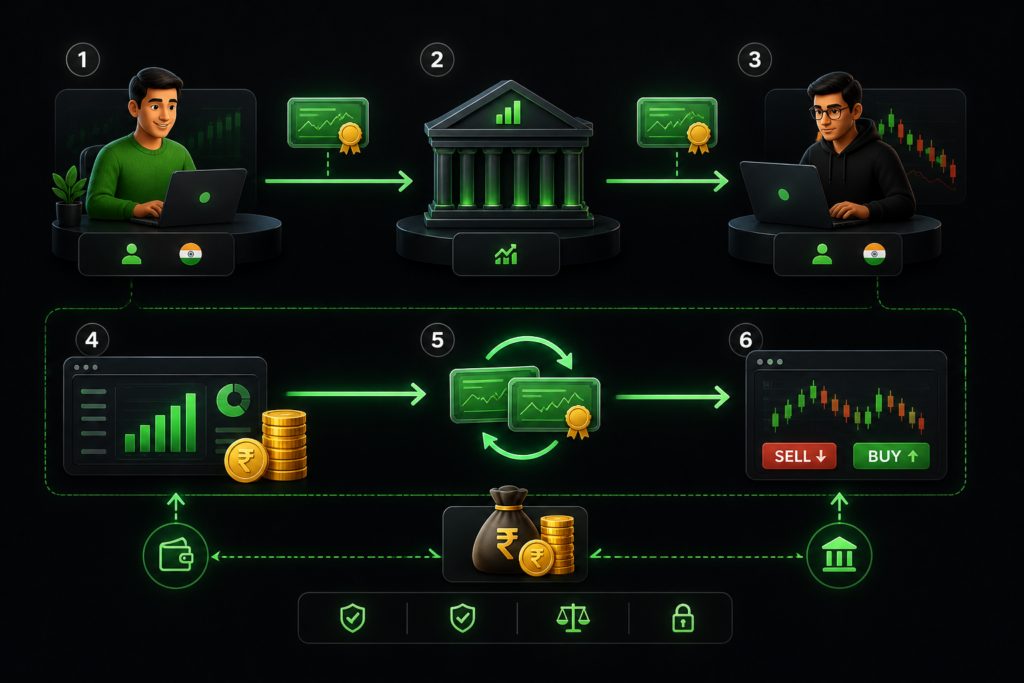
Here’s the exact process simplified:
Step 1: You lend shares
- Through your broker (Zerodha, Angel One, etc.)
- Select stock + quantity + duration
Step 2: Borrower borrows shares
- Pays lending fee
Step 3: You earn income
- Fee credited to your account
Step 4: Shares are returned
- After contract expiry
Simple Timeline
- Day 1 → Lending starts
- During contract → You earn income
- Expiry → Shares automatically returned
Real Example: How Much Can You Earn from SLBM?
Let’s break it down practically.
Scenario:
- You own: 100 shares of Infosys
- Lending rate: ₹15/share/month
Earnings:
- Monthly → ₹1,500
- 3 months → ₹4,500
- Yearly → ₹10,000–₹15,000
👉 And yes:
- You still own the shares
- You still receive dividends
SLBM Charges in India (2026 Updated)
Here’s what you actually pay (and earn):
| Component | Charges |
|---|---|
| Lending Fee | You earn this |
| Broker Charges | ₹20–₹100 per order |
| Exchange Charges | Minimal |
| GST | Applicable |
👉 Based on latest 2026 brokerage structures in India
Which Brokers Offer SLBM in India?
Not all brokers support SLBM.
Comparison:
| Broker | SLBM | Best For |
|---|---|---|
| Zerodha | Yes | Low-cost users |
| Angel One | Yes | Beginners |
| ICICI Direct | Yes | Full-service users |
👉 Before choosing a broker, compare charges:
- Zerodha Brokerage Charges Explained
- Angel One Brokerage Charges Explained
- Upstox Brokerage Charges Explained
Benefits of SLBM (Why Smart Investors Use It)
1. Passive Income
Earn without selling your shares
2. No Impact on Investment Strategy
Continue long-term investing
3. Better Portfolio Returns
Extra income boosts overall return
4. Ideal for Idle Portfolio
Perfect for long-term holders
Risks of SLBM (Don’t Ignore This)
Let’s be clear—SLBM is not completely risk-free.
1. Liquidity Risk
- Not all stocks have borrowers
2. Recall Limitation
- You may not instantly get shares back
3. Limited Stocks
- Only selected stocks allowed
4. Rate Fluctuation
- Lending income is not fixed
👉 According to current market practices in India, risk is controlled but still exists
Who Should Use SLBM? (Clear Decision Guide)
✅ Use SLBM if:
- You are a long-term investor
- Portfolio value is ₹1 lakh+
- You hold large-cap stocks
- You don’t trade frequently
❌ Avoid SLBM if:
- You’re a beginner trader
- You need instant liquidity
- You have a very small portfolio
SLBM vs Dividends vs Trading
| Feature | SLBM | Dividends | Trading |
|---|---|---|---|
| Income Type | Passive | Passive | Active |
| Risk | Low–Medium | Low | High |
| Effort | Low | None | High |
How to Start SLBM in India (Step-by-Step Guide)
Step 1: Open a Demat Account
👉 Read: How to Open a Demat Account in India (2026) – Step-by-Step Guide
Step 2: Understand Basics
👉 Read: What Is a Demat Account
Step 3: Enable SLBM Segment
Step 4: Choose Stocks & Start Lending
👉 Also read:
- Demat Account Charges in India (2026) – Full Cost Breakdown
- Hidden Charges in Demat Accounts Most Investors Ignore
- Best Demat Account for Beginners in India (2026)
Common Mistakes Beginners Make in SLBM
- Lending low-demand stocks
- Ignoring lending rates
- Choosing wrong broker
- Not understanding contract period
Final Verdict: Is SLBM Worth It in 2026?
Here’s the no-nonsense answer:
👉 Yes—but only for the right investor
Best for:
- Long-term investors
- Passive income seekers
- Large portfolio holders
Not for:
- Active traders
- Beginners
- Small portfolios
Final Recommendation:
- Want low cost → Go with Zerodha
- Want ease of use → Go with Angel One
FAQs (Featured Snippet Optimized)
What is SLBM in stock market India?
SLBM is a system where investors lend shares and earn income without selling them.
Is SLBM safe in India?
Yes, it is regulated by exchanges like National Stock Exchange of India, but minor risks exist.
How much can I earn from SLBM?
Typically 1%–5% annually depending on stock demand.
Which broker supports SLBM?
Zerodha, Angel One, and ICICI Direct support SLBM.
