
Table of Contents
- Quick Summary
- What Happened to HDFC Bank Shares?
- Why Did HDFC Bank Shares Fall?
- Why Retail Investors Reacted So Strongly
- Key Numbers Investors Are Watching
- Is This a Fundamental Problem?
- Historical Context: HDFC Bank Has Seen Similar Corrections Before
- What Analysts Are Saying
- Risks Investors Should Understand
- What Could Happen Next?
- Final Verdict
- Frequently Asked Questions
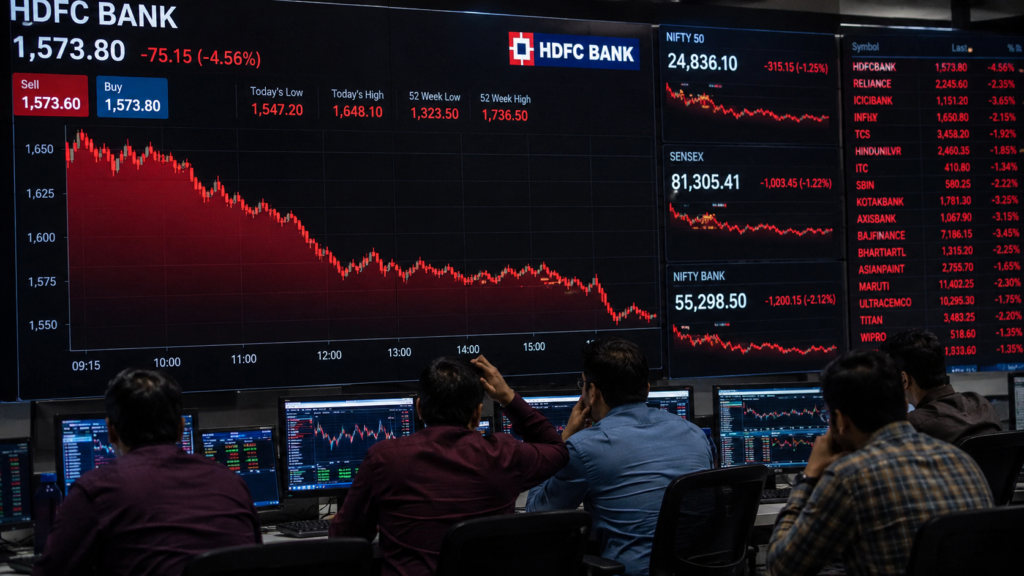
India’s largest private lender suddenly became the center of investor anxiety after HDFC Bank shares witnessed a sharp fall during a weak market session.
For many retail investors, the decline came as a surprise.
After all, HDFC Bank has long been considered one of India’s most trusted blue-chip stocks. It is often seen as a “safe” banking bet for long-term investors. So when the stock drops sharply, panic spreads quickly across investor communities, finance apps, Telegram groups, and social media discussions.
But was this fall simply market noise?
Or is the banking giant facing deeper pressure?
Here’s a complete breakdown of what happened, why investors reacted strongly, and what this means going forward.
Quick Summary
| Factor | Impact |
|---|---|
| HDFC Bank shares fell sharply | Negative sentiment |
| Weak broader market mood | Added selling pressure |
| Foreign investor selling | Major concern |
| Governance discussions resurfaced | Hurt confidence |
| Banking stocks under pressure | Sector-wide weakness |
| Retail investors confused | Search volume spiking |
What Happened to HDFC Bank Shares?
HDFC Bank shares came under heavy selling pressure during a weak trading session where benchmark indices also slipped.
The broader market remained cautious because of global uncertainty, rising geopolitical tensions, and continued foreign institutional investor (FII) selling.
However, HDFC Bank’s decline stood out because banking investors usually expect stability from the stock.
The sharp fall immediately triggered curiosity among retail investors searching for:
- Why HDFC Bank is falling
- Is HDFC Bank still safe
- Should investors buy the dip
- Why banking stocks are weak today
The stock quickly started trending across finance platforms and investor forums.
Why Did HDFC Bank Shares Fall?

There wasn’t just one reason behind the correction.
Instead, multiple factors combined to create panic and selling pressure.
1. Weak Market Sentiment
The Indian market remained volatile amid global uncertainty and geopolitical concerns.
Rising tensions in global markets pushed investors toward safer assets, while emerging markets like India saw pressure from foreign investors reducing exposure.
Banking stocks are usually among the first sectors impacted during risk-off sentiment because large institutional investors often trim exposure quickly.
2. Foreign Investors Continue Selling Indian Equities
Foreign institutional investors have been aggressively selling Indian equities in recent sessions.
This is becoming a major market concern because FIIs hold significant positions in large banking stocks like HDFC Bank.
When FIIs reduce positions, heavyweight stocks often witness sudden sharp corrections even if company fundamentals remain stable.
Retail investors are now increasingly worried about whether this selling trend could continue.
3. Banking Sector Under Pressure
The pressure was not limited to HDFC Bank alone.
Private banking stocks have recently faced valuation concerns after years of strong rallies.
Many analysts believe banking stocks are entering a consolidation phase where earnings growth may not justify premium valuations immediately.
This has resulted in profit booking across several banking counters.
4. Governance and Management Discussions Hurt Sentiment
One of the biggest triggers behind emotional investor reactions was the resurfacing of governance-related discussions in financial media.
Even though no major crisis emerged, investors became cautious because governance concerns can heavily impact valuation multiples in banking stocks.
In India’s stock market, sentiment matters almost as much as numbers.
When investors sense uncertainty around management credibility or strategic direction, short-term selling pressure rises quickly.
Why Retail Investors Reacted So Strongly
HDFC Bank is not a small-cap momentum stock.
It is one of India’s largest wealth creators.
Many SIP investors, mutual fund holders, and long-term portfolios are heavily exposed to the bank.
That is why even a 2–3% fall creates emotional reactions.
For beginner investors, blue-chip stocks are expected to behave “safely.” So when a trusted banking giant falls sharply, fear spreads faster.
Social media discussions amplified this fear.
Many investors started questioning whether:
- the banking rally is ending,
- FIIs are losing confidence,
- or private banks may underperform going forward.
Key Numbers Investors Are Watching
| Indicator | Current Market Focus |
|---|---|
| FII selling activity | High concern |
| Banking sector valuations | Under pressure |
| Nifty Bank movement | Weak sentiment |
| HDFC Bank support levels | Closely watched |
| Institutional buying | Key trigger for recovery |
Investors are also monitoring whether domestic institutions continue supporting banking stocks.
Domestic mutual funds and SIP inflows have helped stabilize Indian markets recently even as foreign investors reduced exposure.
Is This a Fundamental Problem?
At the moment, most analysts still view the situation as sentiment-driven rather than a collapse in business fundamentals.
HDFC Bank remains:
- one of India’s strongest private lenders,
- highly profitable,
- well-capitalized,
- and dominant in retail banking.
However, markets often react emotionally in the short term.
Even fundamentally strong companies can witness sharp corrections if:
- valuations are stretched,
- investors turn risk-averse,
- or global liquidity weakens.
That appears to be the bigger story currently.
Historical Context: HDFC Bank Has Seen Similar Corrections Before

This is not the first time HDFC Bank has gone through a difficult phase.
Historically, the stock has experienced periods where:
- growth slowed temporarily,
- valuations compressed,
- or banking sentiment weakened.
But over long periods, the stock has generally recovered alongside earnings growth.
That said, past performance does not guarantee future recovery.
Today’s market environment is different because:
- global interest rates remain uncertain,
- FIIs are more selective,
- and Indian market valuations are already relatively expensive compared to other emerging markets.
What Analysts Are Saying
Brokerages remain divided on the near-term outlook.
Some analysts believe:
- the correction is temporary,
- strong fundamentals remain intact,
- and long-term investors may continue accumulating gradually.
Others are more cautious.
They believe banking stocks could remain under pressure if:
- global risk sentiment worsens,
- FII selling intensifies,
- or earnings growth disappoints.
Market experts are also emphasizing selective investing rather than aggressive buying across sectors.
Risks Investors Should Understand
Retail investors should avoid emotional decision-making during volatile sessions.
Key risks currently include:
Global Market Volatility
Geopolitical tensions and energy price spikes can impact investor sentiment quickly.
Foreign Investor Selling
Large institutional outflows can pressure heavyweight stocks further.
Valuation Compression
Even strong companies can correct if valuations become too expensive.
Banking Sector Rotation
Investors may temporarily shift money into defensive or high-growth sectors.
What Could Happen Next?
There are three possible scenarios investors are watching closely.
Scenario 1: Recovery Bounce
If global sentiment improves and FIIs slow selling, HDFC Bank could witness bargain buying.
Scenario 2: Range-Bound Consolidation
The stock may move sideways for some time while investors wait for stronger earnings triggers.
Scenario 3: Further Correction
If broader markets weaken sharply, banking stocks could face another round of selling pressure.
Much will depend on:
- institutional flows,
- quarterly earnings,
- and global macro conditions.
Final Verdict
The recent fall in HDFC Bank shares appears more sentiment-driven than fundamentally catastrophic.
However, the correction is still important because it highlights a major shift happening in Indian markets.
Investors are becoming more selective.
Large-cap banking stocks are no longer moving up automatically just because they are market leaders.
For retail investors, this situation is a reminder that even India’s strongest stocks can face volatility during uncertain market phases.
The development currently looks more like a short-term confidence shock rather than a structural collapse.
But if foreign selling and valuation pressure continue, banking stocks may remain volatile for some time.
This is not necessarily a panic situation — but it is definitely a trend worth monitoring closely.
Frequently Asked Questions
Why did HDFC Bank shares fall today?
The stock declined due to weak market sentiment, foreign investor selling, banking sector pressure, and renewed governance-related discussions.
Is HDFC Bank fundamentally weak now?
Most analysts still consider the bank fundamentally strong, but market sentiment has turned cautious.
Are banking stocks under pressure?
Yes, several banking stocks are witnessing consolidation amid valuation concerns and global uncertainty.
Should retail investors panic after the fall?
Market experts generally advise avoiding emotional decisions during volatile phases.
Can HDFC Bank recover from this correction?
Recovery will depend on market sentiment, FII activity, earnings growth, and broader economic conditions.
