
Table of Contents
- Quick Summary
- What Happened in the Market Today?
- Why Did the Stock Market Crash Today?
- Key Numbers Investors Should Know
- How Different Sectors Reacted
- Market Reaction: Fear vs Reality
- What Analysts Are Watching Now
- What Does This Mean for Retail Investors?
- Risks Investors Should Know
- Historical Context: Have We Seen This Before?
- What Could Happen Next?
- Final Verdict
- Frequently Asked Questions
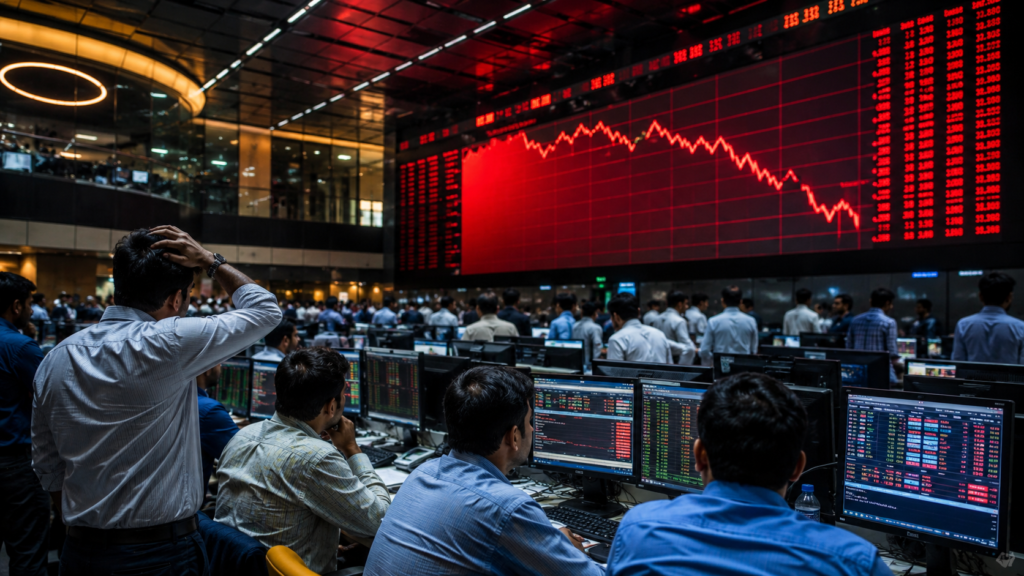
The Indian stock market witnessed one of its most volatile sessions in recent months as investors watched benchmark indices tumble sharply within a few hours. The Sensex plunged more than 1,100 points, while the Nifty slipped below crucial support levels, triggering panic among retail investors.
For many market participants, the sudden fall raised a pressing question: Why did the stock market crash today?
While sharp market declines often feel alarming, they are usually driven by a combination of factors rather than a single event. Today’s sell-off appears to be the result of global uncertainties, foreign investor selling, profit booking, and rising concerns about economic risks.
Before reacting emotionally, investors should understand what actually happened and what it could mean for their portfolios.
Quick Summary
| Key Factor | Impact on Market |
|---|---|
| Foreign Investor Selling | Negative |
| Global Market Weakness | Negative |
| Profit Booking in Large Caps | Negative |
| Rising Risk Sentiment | Negative |
| Increased Volatility | Negative |
| Long-Term Economic Outlook | Largely Unchanged |
Key Takeaways
- Sensex fell more than 1,100 points during the session.
- Nifty witnessed broad-based selling across sectors.
- Foreign institutional investor activity remained under focus.
- Global market concerns added pressure on sentiment.
- Profit booking accelerated after recent market gains.
- Long-term investors are watching developments closely rather than panicking.
What Happened in the Market Today?
Indian equity markets experienced widespread selling pressure as investors rushed to reduce risk exposure.
The weakness was not limited to a handful of stocks. Selling emerged across banking, financial services, information technology, automobiles, and several large-cap counters.
The fall intensified during the latter half of trading as market participants reacted to a combination of domestic and international concerns.
As benchmark indices continued sliding, investor sentiment turned cautious, resulting in increased volatility and panic selling in some pockets of the market.
For retail investors who had become accustomed to strong market rallies over the past few months, today’s decline came as a surprise.
Why Did the Stock Market Crash Today?

Several factors appear to have contributed to today’s sharp market fall.
1. Foreign Investors Turned Risk-Averse
Foreign Institutional Investors (FIIs) play a major role in determining short-term market direction.
When foreign investors pull money out of emerging markets, stock prices often come under pressure.
Global investors are currently evaluating multiple risks including:
- Global economic slowdown concerns
- Interest rate expectations
- Currency fluctuations
- Geopolitical uncertainty
Whenever risk appetite weakens, foreign funds often move capital toward safer assets, affecting markets like India.
Even modest foreign selling can create significant volatility when investor sentiment is already fragile.
2. Profit Booking After Strong Market Gains
Markets rarely move in a straight line.
Over the past several months, Indian equities have delivered strong returns in many sectors. Several stocks reached record highs, leading to stretched valuations in certain areas.
Whenever investors believe gains have become excessive in the short term, profit booking emerges.
Today’s correction appears to include a significant amount of profit-taking from institutional and high-net-worth investors.
Profit booking is a normal market phenomenon and should not automatically be interpreted as a sign of economic weakness.
3. Weak Global Market Sentiment
Indian markets do not operate in isolation.
Investors closely monitor developments in:
- United States markets
- European equities
- Asian stock exchanges
- Commodity prices
- Bond yields
When global markets show signs of weakness, risk sentiment often spills over into Indian equities.
Many traders prefer reducing exposure before uncertainty escalates, which can amplify market declines.
This interconnected nature of global finance means domestic markets frequently react to international developments even when India’s economic fundamentals remain stable.
4. Rising Uncertainty and Investor Nervousness
Financial markets dislike uncertainty.
Whether the concern is inflation, interest rates, geopolitical tensions, commodity prices, or economic growth projections, uncertainty often pushes investors toward caution.
Today’s sharp decline reflects not only actual risks but also investor psychology.
When benchmark indices begin falling rapidly, fear spreads quickly.
This can trigger:
- Panic selling
- Stop-loss activations
- Algorithmic trading pressure
- Increased volatility
As more investors attempt to exit positions simultaneously, declines become steeper.
Key Numbers Investors Should Know
| Indicator | Movement |
|---|---|
| Sensex | Down over 1,100 points |
| Nifty 50 | Sharp decline |
| Market Breadth | Weak |
| Volatility | Elevated |
| Investor Sentiment | Risk-Off |
These numbers highlight the broad-based nature of the correction rather than weakness in a single sector.
How Different Sectors Reacted
Not all sectors reacted equally.
Banking Stocks
Banking stocks witnessed selling pressure due to their significant weight in benchmark indices.
Since banks form a large portion of the Sensex and Nifty, weakness in this sector often magnifies overall market declines.
Information Technology
IT stocks remained sensitive to global growth expectations and international market developments.
Auto Stocks
Automobile companies experienced mixed reactions as investors reassessed growth expectations.
Mid-Cap and Small-Cap Stocks
Historically, smaller companies tend to experience larger swings during periods of market volatility.
As a result, several mid-cap and small-cap stocks witnessed sharper declines compared to benchmark indices.
Market Reaction: Fear vs Reality
One of the most important lessons for investors is understanding the difference between market sentiment and economic reality.
Markets often react immediately.
Economic fundamentals change more slowly.
A single day of sharp decline does not necessarily indicate a major economic problem.
In many cases, markets overreact in both directions.
During bull markets, optimism can become excessive.
During corrections, fear can become excessive.
Successful investors often focus on distinguishing temporary sentiment shifts from meaningful long-term changes.
What Analysts Are Watching Now
Market experts are closely monitoring several indicators.
Foreign Fund Flows
Continued foreign selling could keep volatility elevated.
Corporate Earnings
Strong earnings growth may help stabilize sentiment.
Interest Rate Outlook
Any changes in global interest rate expectations can influence capital flows.
Economic Growth Data
Investors will watch upcoming economic indicators for signs of strength or weakness.
Volatility Index
A sustained rise in volatility could signal continued nervousness among traders.
What Does This Mean for Retail Investors?

Retail investors often feel the greatest emotional impact during sharp market declines.
Seeing portfolio values fall can trigger anxiety and impulsive decision-making.
However, history shows that reacting emotionally during corrections often leads to poor outcomes.
Instead, investors should focus on:
- Reviewing portfolio quality
- Maintaining diversification
- Avoiding panic-driven decisions
- Understanding the reasons behind market moves
- Keeping long-term goals in mind
The key question is not whether markets will experience corrections.
The key question is whether investors are prepared for them.
Corrections are a normal part of investing.
Risks Investors Should Know
Although today’s decline may simply represent a correction, risks remain.
Risk 1: Extended Foreign Selling
Persistent foreign outflows can create additional pressure.
Risk 2: Global Economic Weakness
A slowdown in major economies could affect market sentiment.
Risk 3: Higher Volatility
Sharp swings may continue over the coming sessions.
Risk 4: Sector-Specific Weakness
Some sectors may underperform even if broader markets recover.
Understanding these risks helps investors approach market movements with greater clarity.
Historical Context: Have We Seen This Before?
Yes.
Indian markets have experienced multiple corrections over the past decade.
Examples include:
- COVID-19 crash in 2020
- Inflation-driven volatility in 2022
- Various geopolitical-event corrections
- Interest-rate-driven market declines
In each case, markets eventually stabilized and resumed their long-term trajectory.
This does not guarantee future performance, but it highlights an important fact:
Market corrections are not unusual.
They are a recurring feature of investing.
What Could Happen Next?
Several scenarios are possible.
Scenario 1: Quick Recovery
If sentiment improves and selling pressure eases, markets could rebound.
Scenario 2: Consolidation Phase
Indices may trade within a range as investors evaluate fresh data.
Scenario 3: Further Correction
Additional negative developments could extend volatility.
At this stage, markets appear focused on incoming economic and global signals.
The next few trading sessions may provide greater clarity regarding the direction of sentiment.
Final Verdict
Today’s sharp market fall has undoubtedly unsettled investors, but it is important to separate emotion from analysis.
The decline appears to be driven by a combination of foreign investor caution, global market weakness, profit booking, and rising uncertainty.
For long-term investors, this event currently looks more like a market correction than a structural breakdown of India’s growth story.
That does not mean risks have disappeared.
Volatility could remain elevated, and further declines are always possible.
However, history suggests that market corrections are a normal part of wealth creation journeys.
Rather than viewing every sharp decline as a crisis, investors may benefit from understanding what is driving market movements and monitoring developments carefully.
At this stage, the situation appears worth watching closely rather than treating as a reason for panic.
Frequently Asked Questions
Why did the stock market crash today?
The decline was driven by a combination of foreign investor selling, profit booking, global market weakness, and increased uncertainty among investors.
Why did Sensex fall over 1,100 points?
Broad-based selling across major sectors combined with negative market sentiment led to the sharp decline.
Is this a stock market crash or a correction?
Many analysts currently view it as a market correction rather than a full-scale market crash, although future developments remain important.
Should retail investors panic after today’s fall?
Market declines can be uncomfortable, but panic-driven decisions often create additional problems. Understanding the reasons behind the fall is essential.
Can markets recover after such declines?
Historically, Indian markets have recovered from multiple corrections, although the timing and pace of recovery vary.
What should investors watch next?
Key factors include foreign fund flows, corporate earnings, global market trends, economic data, and overall investor sentiment.
Are market corrections normal?
Yes. Corrections are a natural part of financial markets and occur regularly during long-term market cycles.
